/ / /
第9讲 正交和线性变换(Orthogonality and Linear Transformations)
🔴
入学要求
💯
能力测试
🛣️
课程安排
🕹️
研究资源

第9讲 正交和线性变换(Orthogonality and Linear Transformations)

💡
查看全集:🏸线性代数/Linear Algebra

一、过渡矩阵(Transition Matrix)

1.1 基本定义

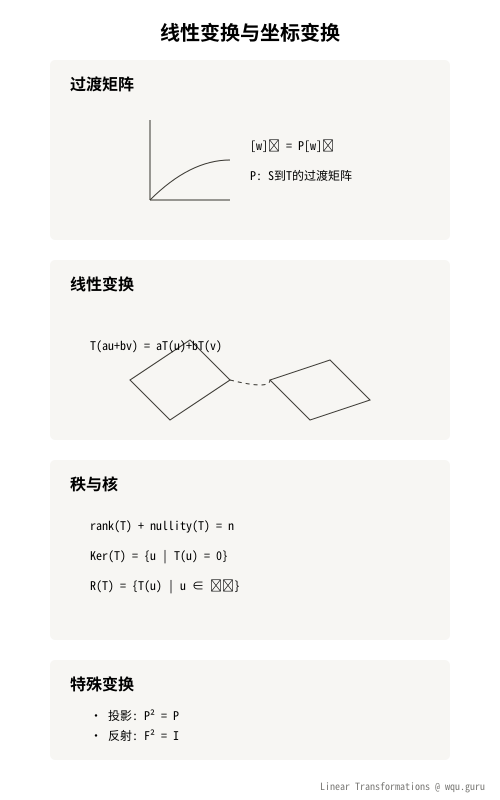
设 S={u1,...,un}S = \{ \mathbf{u}_1,...,\mathbf{u}_n \} 和 T={v1,...,vn}T = \{ \mathbf{v}_1,...,\mathbf{v}_n \} 是 n 维向量空间 V 的两个基,则从 S 到 T 的过渡矩阵 P 由下式唯一确定:

 (u1,...,un)=(v1,...,vn)P (\mathbf{u}_1,...,\mathbf{u}_n) = (\mathbf{v}_1,...,\mathbf{v}_n)P

其中 P 的列向量为 [u1]T,...,[un]T[\mathbf{u}_1]_T,...,[\mathbf{u}_n]_T。

坐标转换公式:对任意向量 w\mathbf{w},有

 [w]T=P[w]S [\mathbf{w}]_T = P[\mathbf{w}]_S

1.2 旋转坐标系示例

考虑 xy 坐标系绕原点逆时针旋转 θ 角得到 x'y' 坐标系的情况:

P=(cos⁡θ−sin⁡θsin⁡θcos⁡θ),P−1=(cos⁡θsin⁡θ−sin⁡θcos⁡θ)P = \begin{pmatrix} \cosθ & -\sinθ \\ \sinθ & \cosθ \end{pmatrix}, \quad P^{-1} = \begin{pmatrix} \cosθ & \sinθ \\ -\sinθ & \cosθ \end{pmatrix}

例:θ = 60° 时:


P=(1/2−3/23/21/2)P = \begin{pmatrix} 1/2 & -\sqrt{3}/2 \\ \sqrt{3}/2 & 1/2 \end{pmatrix}

点 P 在 xy 系的坐标 (2,1) 转换为 x'y' 系坐标为:


P−1(21)=(1+3/21/2−3)P^{-1}\begin{pmatrix}2\\1\end{pmatrix} = \begin{pmatrix} 1+\sqrt{3}/2 \\ 1/2-\sqrt{3} \end{pmatrix}


二、线性变换基础

2.1 定义与标准矩阵

线性变换 T:Rn→RmT: \mathbb{R}^n \to \mathbb{R}^m 的标准矩阵 A 满足:

T(x)=Ax=(a11⋯a1n⋮⋱⋮am1⋯amn)(x1⋮xn)T(\mathbf{x}) = A\mathbf{x} = \begin{pmatrix} a_{11} & \cdots & a_{1n} \\ \vdots & \ddots & \vdots \\ a_{m1} & \cdots & a_{mn} \end{pmatrix} \begin{pmatrix}x_1\\ \vdots \\x_n\end{pmatrix}

构造方法:计算标准基向量的像

A=[T(e1) ∣ T(e2) ∣ ⋯ ∣ T(en)] A = [T(\mathbf{e}_1)\ |\ T(\mathbf{e}_2)\ |\ \cdots\ |\ T(\mathbf{e}_n)] 

2.2 重要性质

  1. 线性性:T(au+bv)=aT(u)+bT(v)T(a\mathbf{u}+b\mathbf{v}) = aT(\mathbf{u}) + bT(\mathbf{v})
  1. 复合变换:(T∘S)(u)=T(S(u))(T \circ S)(\mathbf{u}) = T(S(\mathbf{u})) 对应矩阵 BA
  1. 零向量保持:T(0)=0T(\mathbf{0}) = \mathbf{0}

三、秩与核(Rank and Kernel)

3.1 基本概念

设线性变换 T:Rn→RmT: \mathbb{R}^n \to \mathbb{R}^m 的标准矩阵为 A

3.2 秩-零化度定理

 rank(T)+nullity(T)=n \text{rank}(T) + \text{nullity}(T) = n

几何解释:


四、典型例题解析

4.1 投影变换

定义投影变换 P(x)=x−(n⋅x)nP(\mathbf{x}) = \mathbf{x} - (\mathbf{n}\cdot\mathbf{x})\mathbf{n},其中 ∥n∥=1\|\mathbf{n}\|=1

标准矩阵:

P=I−nnTP = I - \mathbf{n}\mathbf{n}^T

性质验证:

P2=P(幂等性) P^2 = P \quad (\text{幂等性}) 

4.2 反射变换

定义反射变换 F(x)=x−2(n⋅x)nF(\mathbf{x}) = \mathbf{x} - 2(\mathbf{n}\cdot\mathbf{x})\mathbf{n}

正交性验证:

F∘F=I且FT=FF \circ F = I \quad \text{且} \quad F^T = F

五、学习建议

  1. 几何直观:将线性变换理解为空间的旋转/投影/缩放操作
  1. 矩阵联系:熟练掌握标准矩阵的构造方法
  1. 特殊变换:重点理解正交矩阵、投影/反射矩阵的特性
  1. 维度分析:用秩-零化度定理验证计算结果

关键术语表:

附:练习合集